PhD defence ceremony by Emma Polman
Grazing and Flooding in a Novel Grassland-Wetland Ecosystem: How herbivore exclusion and winter inundation impact carbon cycling and vegetation structure
Event details from: PhD defence ceremony by Emma Polman
- Date
- 26 November 2026
- Time
- 16:00
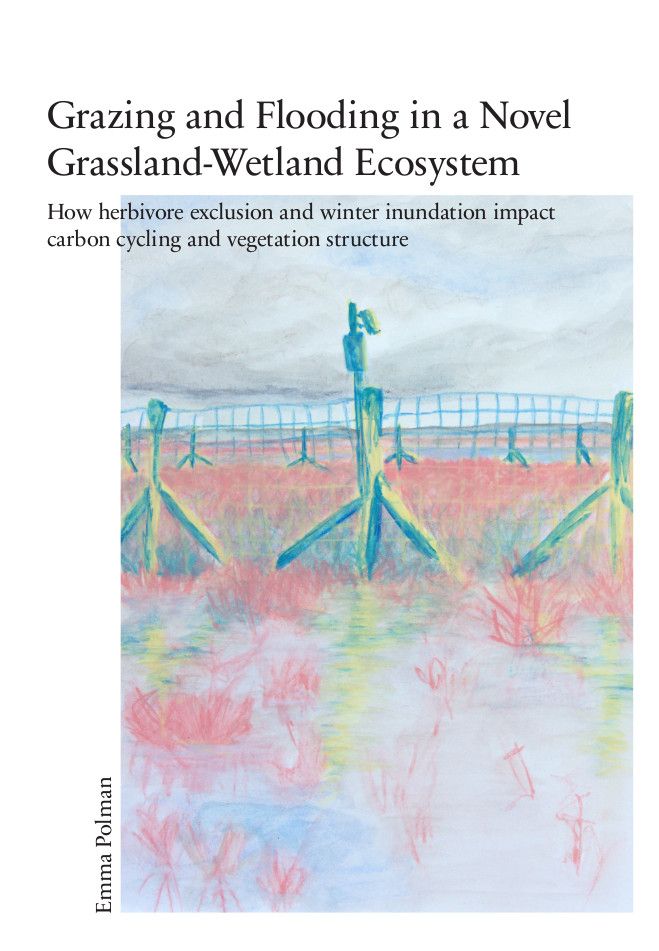
Seasonal inundations and large, ungulate herbivore grazing are two commonly used management strategies for introducing natural disturbances and dynamics in managed grassland-wetland systems. These strategies are often used for creating habitat diversity by influencing vegetation structure and plant community composition, but also have a large potential impact on soil carbon (C) cycling with consequences for soil organic carbon (SOC) pools. In this thesis I aimed to get insight into how winter inundation and herbivore exclusion interactively influence soil and vegetation properties in a Dutch wetland-grassland area. Winter inundation had a substantial effect on plant community composition, vegetation structure and soil C cycling processes, and it changed the relationships between soil, vegetation and microbial community properties and SOC stocks. Short-term (1 to 2 year) grazing exclusion caused a drastic change in vegetation structure in both dry and winter inundated grassland, with the strongest effect on vegetation height and biomass, that both increased in exclosures. Winter inundation also increased the positive effect of herbivore exclusion on ecosystem respiration, and led to an increase in SOC concentrations in exclosures, mainly through the formation of stabile mineral associated organic C. These results suggest that diversity in plant community composition and vegetations structure can be promoted in the Oostvaardersplassen by having spatial and temporal variation in grazing patterns, and that this will likely not result in a short-term depletion of SOC stocks and associated functions. However, for understanding long-term effects on C cycling and vegetation structure, long-term experiments are necessary.