Ancestor of all archaea was a heat-loving methane producer
A key paper of the ERC starting grant ASymbEL of Anja Spang and the doctoral research of Wen-Cong Huang, whose PhD defence at the University of Amsterdam is scheduled for December, was published in Nature Communications in August. The study has now been selected as one of 50 highlights on the journal’s Editors’ Highlights page for Microbiology and infectious diseases.
Hidden diversity
Archaea are one of the two primary domains of cellular life, alongside bacteria. Complex eukaryotic cells, including our own, ultimately descend from an archaeal host. Archaea were long thought to be neither diverse nor abundant, partly because they are hard to grow in the lab.
It is now clear they live almost everywhere, from oceans and lakes to hot springs, soils and animals.
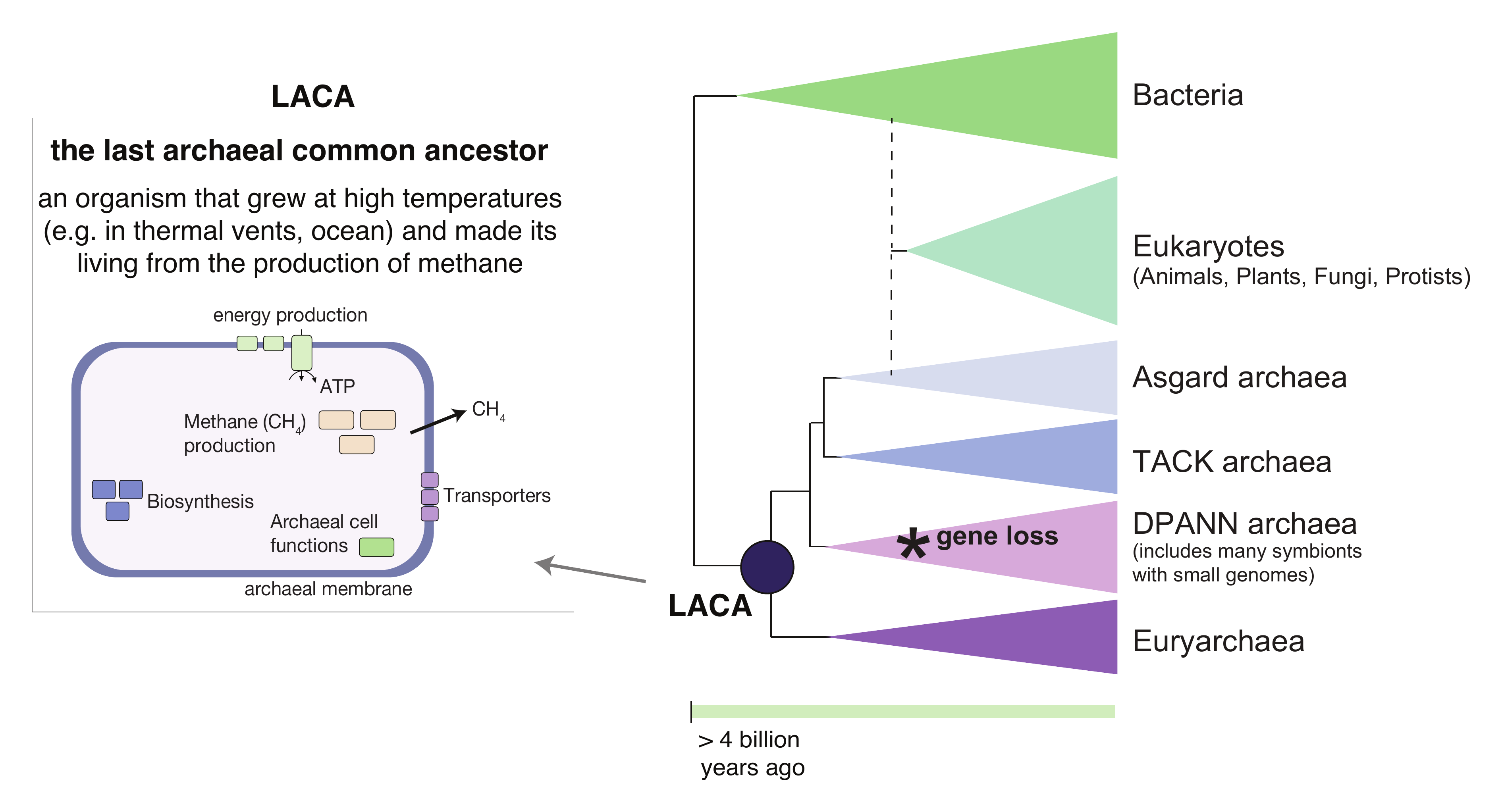
Metagenomics, which allows to sequence DNA directly from environmental samples and reconstruct microbial genomes, has led to the description of the DPANN archaea. They are named after their first described lineages: Diapherotrites, Parvarchaeota, Aenigmarchaeota, Nanoarchaeota and Nanohaloarchaeota including the first cultivated member of the group - Nanoarchaeum equitans. This diverse group has small genomes, and cultivated members depend on host organisms, such as other archaea, to survive. Most earlier studies placed DPANN at the base of the archaeal tree. Testing that idea was a central aim of the research.
A methane-producing ancestor
The team, including various international collaboration partners, used new phylogenetic and ancestral genome reconstruction methods suited to reconstruct very ancient relationships. These methods allowed the researchers to locate the root region of the archaeal tree and trace the evolution of every gene family through billions of years. In contrast to previous work, the methods used did not assume that all genomes evolve at the same rate. This matters because symbionts often lose genes more rapidly.
The results indicate that DPANN are not an early-diverging branch, and that earlier findings were likely methodological artefacts. Instead, the tree is rooted between some or all Euryarchaeota and the remaining archaea. The last archaeal common ancestor was not genome-reduced. It was predicted to be a heat-loving, methane-producing organism, which fits the idea that methane production evolved very early in Earth history. DPANN, by contrast, evolved mainly through gene loss and became increasingly dependent on hosts.
The findings shed light on the deepest branches of the tree of life. They also provide a firmer basis for linking microbial evolution with Earth’s history.
Wen-Cong Huang
Nina Dombrowski