Temporal altitudinal Biogeographic shifts
4 December 2025
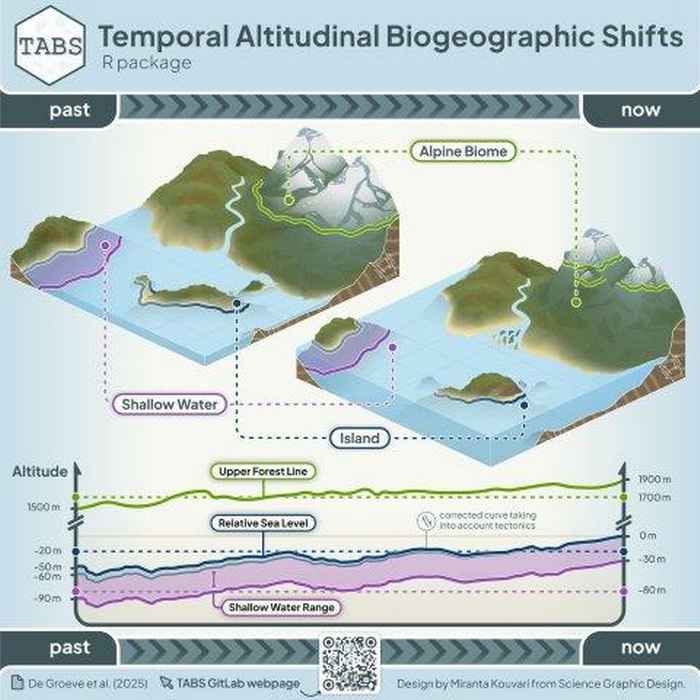
Designed for altitude-bounded systems such as island archipelagos, alpine zones, coral reefs, and continental shelf seas, tabs can incorporate sea-level change, forest-line movement, and even geophysical or tectonic effects, such as gradual changes in topography caused by uplift and subsidence. It can also project future spatial configurations under climate scenarios, allowing researchers to examine how biogeographic systems have changed in the past, how they function today, and how they may evolve in the future.
By revealing how biogeographic systems expand, fragment, and reconnect through time, tabs offers opportunities to understand biodiversity patterns and species distributions in a dynamic Earth system.
Reference
De Groeve J, Rijsdijk KF, Rentier ES, Flantua SGA, Norder SJ (2025) Temporal Altitudinal Biogeographic Shifts (tabs): R package for reconstructing biogeographic shifts in terrestrial and marine systems over time. Frontiers of Biogeography 18: e151677. https://doi.org/10.21425/fob.18.151677