NWO awards KIC grant for new consortium led by IBED researchers
30 April 2026
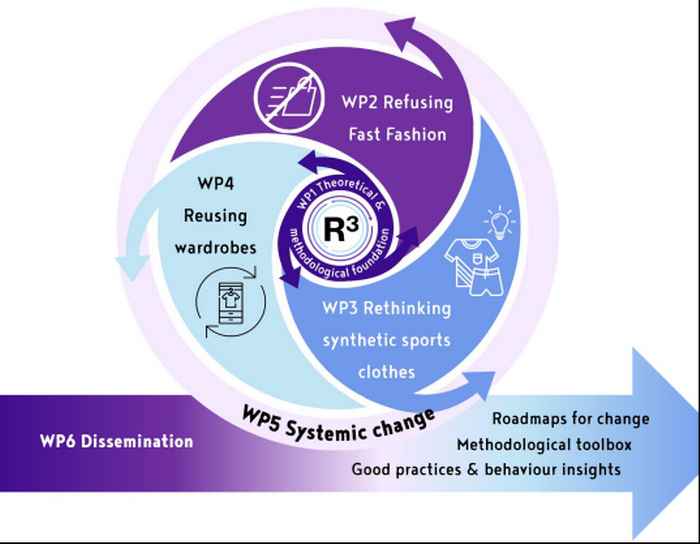
The clothing industry is one of the most polluting sectors worldwide and, per EU resident, consumes enormous amounts of CO2, water, land and raw materials, with synthetic (fossil-based) fibers accounting for a large share of the impact and continuing to release microplastics during use. Despite this environmental damage, the clothing market keeps growing, driven by fast fashion, cheap synthetic sportswear, and e-commerce platforms, while circular businesses struggle to scale up and turn the tide.
R3CIRCLE brings together 10 universities of applied sciences and research universities, and 32 societal partners to explore how various interventions targeting fast fashion can be designed, tested, and scaled up to change consumer practices and foster a more circular clothing system.
Consumers play a pivotal role in shaping the textile industry and its environmental impact. Purchasing, usage and disposal behavior create a cycle of demand between consumers and businesses. Although nearly 60% of Dutch residents express concern for the environment and interest in sustainable fashion, this concern does not translate to behavioral change that lowers environmental impact.
Within R3CIRCLE, researchers will establish living labs focused on “refusing fast fashion”, “rethinking sports clothing” and “reusing existing wardrobes”, developing interventions to help support different target groups in making sustainable choices. By quantifying the environmental impact of these interventions, stakeholders can scale up successful interventions and embed them in various online and real-life contexts. At the UvA, we will develop a theoretical framework on measuring behavioral change and subsequently modelling its impact on planetary health. The project will be coordinated by Lies Jacobs, who together with Antonia Praetorius will coordinate the environmental impact modelling.
<<< With R3CIRCLE we want to move the needle towards sustainable textile consumption through interventions that have demonstrable impact on planetary health. Through collaboration with governmental, non-governmental and commercial partners we aim to co-create interventions that are tested within real-life settings and scaled up within (and beyond) our project. >>> L. Jacobs