Radar data can help protect birds from wind turbines
1 July 2026
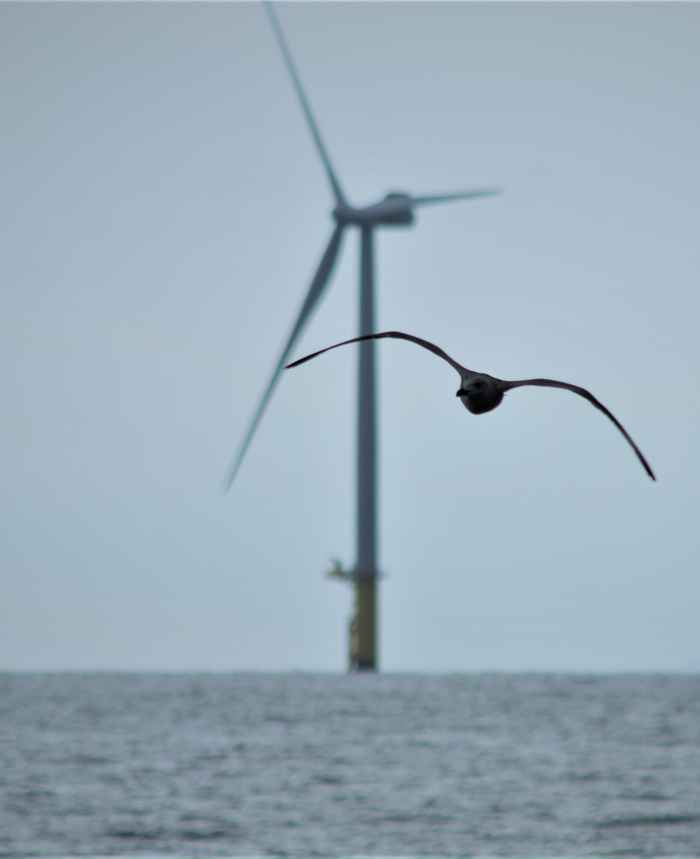
How many birds collide with wind turbines? In the continental United States, the annual figure is estimated to be between 140,000 and 330,000; however, there are no estimates for Europe, particularly for migratory birds during their nighttime migrations. Some measures are already in place, such as shutting down turbines during periods of heavy migration—on a single autumn night, an estimated 188 million birds may be on the move simultaneously in Europe. At the Gotthard Pass—a migration corridor used by 1.7 million migratory birds annually—the turbines shut down when a local bird radar detects a large number of birds. This helps reduce potential collisions.
However, around 25,000 new wind turbines are set to be built in Europe over the next few years to meet emissions targets. Even though the number of birds killed annually is unknown, the threat to migratory birds will continue to grow, and their populations are already declining sharply worldwide. This calls for automated and scalable monitoring methods that operate on a significantly larger scale.
Watching birds instead of weather
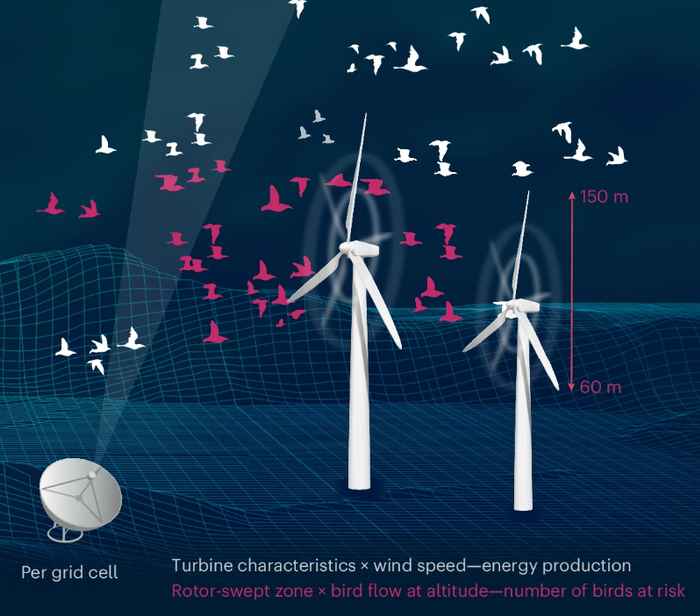
To address these challenges, the team led by biodiversity researcher Silke Bauer of the WSL uses data from weather radars distributed across the continent. They normally measure precipitation and cloud density in the atmosphere. However, these radar systems also track the movements of flocks of birds—and cover much larger areas than specialized bird radars. In addition, weather radar data is available at high spatial and temporal resolution, with measurements taken approximately every 15 minutes.
In the latest study, published in Nature Sustainability, the research team analyzed weather radar data from Germany, France, Belgium, the Netherlands, and Luxembourg. These countries are home to approximately 42,000 wind turbines, which generated about 718 petajoules of energy in 2018—the study’s base year—equivalent to roughly the annual output of 18 nuclear power plants. Using data from 37 weather radars and complex statistical analyses, the researchers estimated the number of birds that could potentially have collided with the rotor blades in 2018. On average, nearly 800 birds per turbine were considered at risk.
Only Minor Losses in Electricity Production
The researchers then modelled various shutdown scenarios designed to prevent either 50 or 90 percent of potential collisions. In one scenario, the turbines were shut down during the period of peak bird migration. In the second scenario, the turbines stopped whenever the bird density in the surrounding area exceeded a certain threshold. In the third scenario, the turbines shut down when the number of potential collisions per kilowatt-hour of electricity generated exceeded a defined limit.
The first two scenarios are less attractive to operators because they reduce electricity production by 2 to 20 percent, depending on the bird protection goals. In the third scenario, however, operators would lose only 1.2 or 7.6 percent of their electricity—surprisingly little given the study’s rather rough assumptions. “Surprisingly efficient compromises are possible, with only minimal loss of energy production,” notes Bauer. She now wants to extend the calculations to cover all of Europe and longer time periods.
The biannual bird migration is an important part of biodiversity. Since the majority of migration takes place within a relatively narrow time window and the peaks of these movements are concentrated in relatively short phases, time-limited and thus cost-effective restrictions on wind power production could suffice. According to the researchers, this is most likely to be achieved through cross-border regulations and coordination—both to protect migratory birds and to meet climate targets.
“Many people oppose wind turbines because they believe they kill a huge number of birds,” says Bauer. “I want to reconcile sustainable energy production with bird conservation and demonstrate that there are strategies to reduce the number of birds at risk.”