FlySafe service to observe bird migration and reduce bird strikes in military flights
25 August 2026
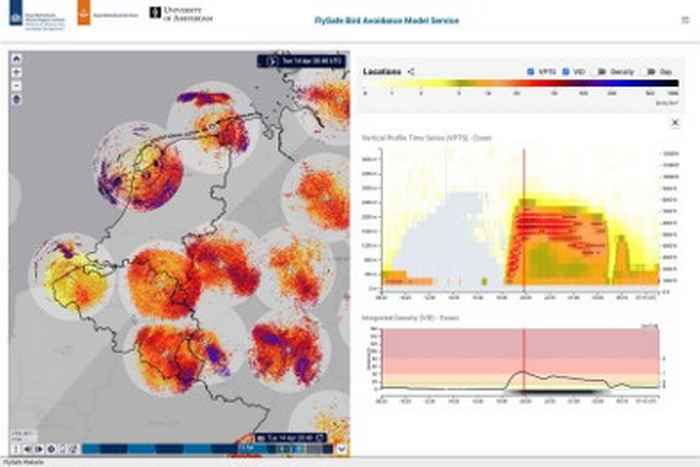
Millions of birds pass through the Netherlands each year as part of their natural migration, but can intersect with aircraft. The new FlySafe dashboard provides real-time and predictive data on bird migration, reducing bird strikes and improving flight safety. The tool was developed in collaboration between the Institute of Biodiversity and Ecosystem Dynamics at the University of Amsterdam, The Royal Netherlands Air and Space Force, and the Royal Netherlands Meteorological Institute (KNMI).
Addressing bird strike risks
Birds share the air with aircraft. Collisions, or “bird strikes,” can be serious and sometimes devastating. While birds may cross paths with commercial airplanes, military aircraft are a larger problem. These planes fly at lower altitudes, in the same airspace where birds migrate.
Bird strikes affect the birds, often killing them on impact. If the bird is large enough or the aircraft speed is high enough, there can also be aircraft damage. Sources estimate that collisions between birds and aircraft cost billions of euros annually.
On an airbase, birds can be scared away from the runway. But they cannot be scared away mid-flight. The only solution to prevent bird strikes, is to close the airspace when there are too many birds in the air.
Prior research shows that bird strikes are, on average, 45% less frequent in countries with implemented systems in place. FlySafe addresses this by providing data that gives pilots warnings when large migration waves occur.
A “live view” of migration
The first iteration of FlySafe was created in 2008 to help reduce bird strike risk with military aircraft and improve flight safety in northwest Europe. As the first of its kind in Europe, researchers built a forecast model based on three years of data from the Royal Netherlands Air Force. But it’s not only air defense radar that can detect birds: weather radars are an important resource and much easier to access with respect to safety and security. The new FlySafe dashboard integrates weather data from the meteorological services of the Netherlands, Belgium, and Germany to allow for a clearer picture of migration activity.
The interactive website has two components. There is a page for observed migration, which provides 5-minute real-time data on bird migration in the Netherlands, Belgium, and Germany, as measured by weather radar.
“We now have a live view of bird migration,” says Bart Kranstauber, a computational ecologist at IBED. “You can see what altitude they're flying at, the patterns, where the highest densities of birds are, and the propagation of migration waves.”
FlySafe also has a predictive component. By gathering weather data and linking this to past migration, researchers created a model to help predict migration several days in advance.
Applications beyond aviation
FlySafe can help the air force make flight decisions. But it can help researchers generate knowledge about bird migration and weather, as this data has not been as seamlessly integrated before. The web service is also designed to be scalable and can be expanded to other countries.
The system is accessible to the general public. There is a large community of people watching birds during migration in the Netherlands, and this dashboard is also a resource for them.
“It is free-to-use to the whole community that watches visible bird migration,” says Hans van Gasteren, head of the Royal Netherlands Air Force Nature Bureau.
About FlySafe: The FlySafe Operational Service provides near real-time information and forecast on large scale bird movement in the air space of The Netherlands, Germany and Belgium based on weather radars.
This information is used by airforces to create and disseminate BIRDTAM’s (bird notice to airmen) to their pilots, enabling them to adjust their operations and avoid collisions between military aircraft and birds.